
Mayor Caroline Woodley and Hackney Councillors with Will Prochaska from CEGA.
Councils across the UK have come together to say no to gambling advertising. Ten new councils – Barnet, Blackpool, Brent, Bristol, Devon, East Suffolk, Enfield, Hackney, Lewisham, and Southampton – have joined the Coalition to End Gambling Ads (CEGA) in a united stand against the spread of harmful gambling promotions.
“It’s inspiring to see councils stepping up to protect the health of their populations where national government is still wanting,” says Will Prochaska, CEGA’s director.
“Councils across the UK are recognising that gambling is a public health crisis fuelled by relentless advertising.”
While more than 80 councils already restricting gambling ads on the spaces they control, they remain powerless over privately owned spaces including billboards, transport networks, broadcast media, and the internet.
Recent government statistics show that 2.7% of UK adults – around 1.4 million people – have a gambling problem. The Department of Health and Social Care estimates that between 117 and 496 suicides each year in England are linked to gambling.
The gambling industry currently spends around £2 billion a year on advertising, embedding gambling into everyday culture and exposing millions, including children and young people, to harmful marketing.
In 2024 the WHO joined calls to end gambling advertising calling for universal, population-wide public health approaches to prevent gambling harm. Some private media outlets, such as the Guardian, have voluntarily chosen to reject gambling advertising, as have a range of football clubs, but if children and families are to be protected the Coalition to End Gambling Ads says much more needs to be done.
In January 2025 Haringey Council became the first to join the Coalition. Now the expanded membership comes as more councils are pushing back against the harm caused by gambling. This year Brent Council, supported by over 40 others, has written to the government asking for a six-point plan of action to help curb the harm caused by the industry, and the Mayor of Greater Manchester has also joined calls to clamp down on the industry.
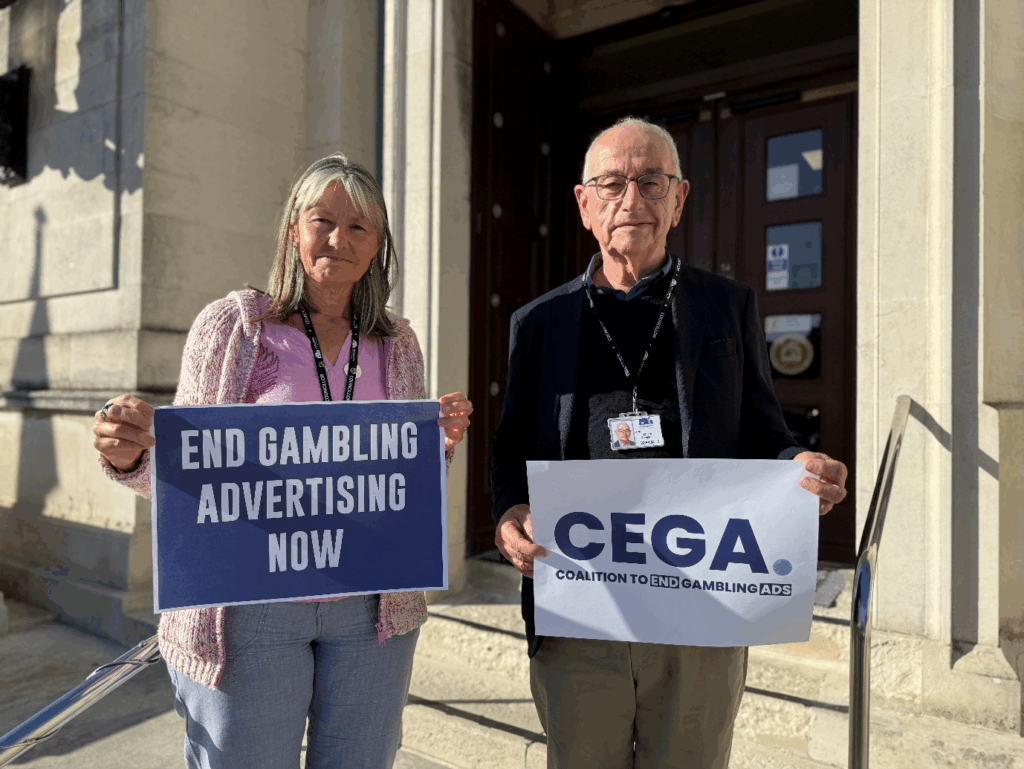
Councillor Marie Finn and Councillor Gordon Cooper from Southampton City Council
Restricting gambling ads is also popular with the public: new CEGA polling of more than 2,000 GB adults shows that 70 per cent of Britons want gambling advertising to be banned or restricted, and 68 per cent think children shouldn’t see gambling ads.
The ten new councils announcing their membership of CEGA join the UK’s leading public health bodies already in the Coalition, including the Royal Society for Public Health, the Association of Directors of Public Health, and the Faculty of Public Health.
“By joining this coalition, councils are standing up for their communities and sending a clear message: it’s time to stop allowing companies to profit from promoting harmful products,” says Will Prochaska. “We urge others to follow their lead.”
Quotes from new council members:
Councillor Marie Finn, Cabinet Member for Adults and Health at Southampton Council, said:
“We’re really pleased to be the latest member of the Coalition to End Gambling Ads. The negative harms caused by gambling, whether it’s physical, financial, mental or social, are all heavily influenced by gambling advertising. We’re passionate about making Southampton safer, healthier and more equal for our residents.”
Councillor Gordon Cooper, from Southampton Council, said:
“Now is the time for us to recognise the gambling harms in our city and for us to work together with partners and communities across the city, using best practice, to reduce the harm that comes from gambling. It is our ambition to raise the profile of local action and ensure that those who are particularly at risk have the right support available to them.”
Councillor Chris Kennedy, Cabinet Member for Health, Adult Social Care at Hackney Council said:
“Hackney Council takes a ‘health in all policies’ approach to everything we do. Gambling related harm is well documented but not well recognised as it is often a highly stigmatised form of damage in the lives of some of our most deprived citizens.
“This is why our advertising policy clearly states that we will not support material that promotes gambling products, services or organisations. We are therefore delighted to join this partnership with CEGA, national public health bodies, and fellow local authorities.”
East Suffolk Council Leader, Cllr Caroline Topping said:
“This is a subject that I feel very strongly about. I have been speaking out against this and for toughening up gambling restrictions since I was at Waveney District Council. I’m pleased to support the campaign and for the Council be part of the Coalition in order to strengthen restrictions.”
Cllr Jan Candy, East Suffolk cabinet member for Community Health, said:
“For many, gambling can be enjoyed as harmless entertainment. But, for a significant minority, it can become a destructive addiction and have severe financial and social consequences.
“Gambling advertising is often difficult to avoid encountering – and that applies for young, susceptible and vulnerable people.
“Joining the Coalition demonstrates our support for stopping the negative impacts and reducing the risk of harm caused by gambling.”
Cllr Jo Farrell, Cabinet Member for Communities and Wellbeing at Blackpool Council said:
“Blackpool Council acknowledges that gambling is a lawful leisure activity and part of the entertainment offer available to our communities and the millions of visitors who come to Blackpool each year.
“However, we also recognise that gambling-related harm is a significant, yet often hidden and stigmatised, public health issue.
“Evidence shows that gambling advertising can contribute to negative outcomes for our residents and their families.
“We welcome the partnership with CEGA to support efforts to end gambling advertising both locally and nationally. Together, we aim to create a safer environment, reducing the risks associated with gambling harm.”
Councillor Tony Dyer, Leader of Bristol City Council and Chair of the Strategy and Resources Committee, said:
“Gambling is a popular form of entertainment for many but the negative impact it can have is well documented. Bristol City Council recognises this impact and is partnering with CEGA to help protect the vulnerable against the harm gambling advertising can cause.
“Our existing advertising policy already reflects this commitment, and we’re proud to support a wider movement for strong national action.
“By opening up conversations about how deeply embedded gambling has become in our daily lives through advertising, we can work to protect residents locally and, with the support of CEGA and other councils, drive change nationally.”
Press Contact
Nick Harvey [email protected]