Gambling lobby’s advertising report for government is “flawed and biased”
CEGA-commissioned research shows a report commissioned by the Betting and Gaming Council (BGC) to inform the government’s review of gambling advertising suffers “a number of flaws and biases”.
An analysis by Landman Economics [Click Here] found the BGC-commissioned report focused almost solely on the benefits of gambling advertising, such as job creation, while largely ignoring its role in gambling-related harm.
Around 1.4 million people in the UK experience a gambling problem, and the gambling sector spends approximately £2bn a year on gambling advertising.
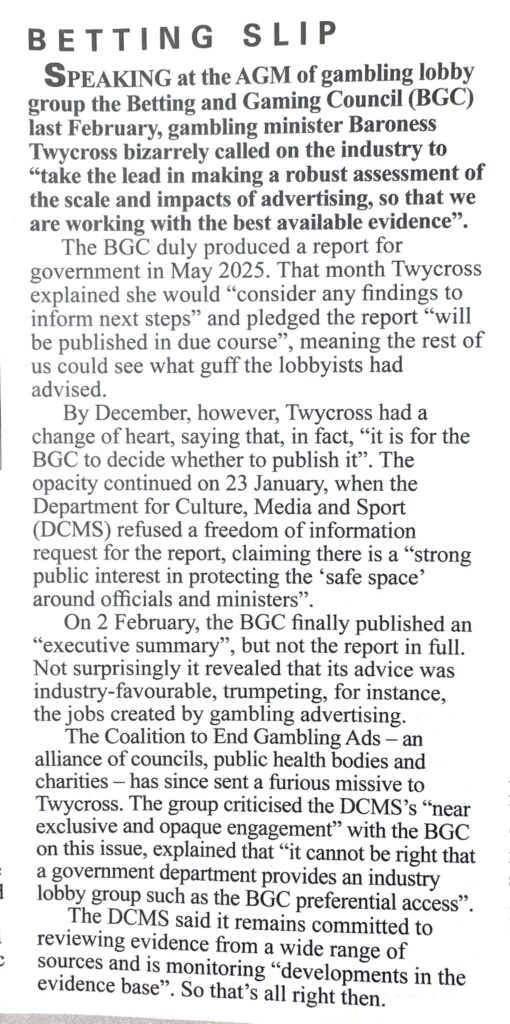
The Government had asked the BGC to inform its gambling advertising policy review, as they wanted the industry to “take the lead in making a robust assessment of the scale and impacts of advertising”.
Both the BGC and the Government did not initially publish the report, with the BGC eventually publishing the executive summary while the full report remains hidden.
Landman Economics concluded that “the failure of the BGC – and the Department for Culture, Media and Sport (DCMS) – to make the full text of the report publicly available shows a worrying lack of transparency regarding interactions between the UK Government and the BGC, and the precise content of the report”.
CEGA’s Will Prochaska wrote to DCMS’s gambling Minister, Baroness Twycross, to express concern at the DCMS’s “near exclusive and opaque” engagement with the Betting and Gaming Council (BGC) when reviewing government policy on gambling advertising.
The letter, covered by Private Eye highlighted how the BGC should not be seen as a credible partner for such a review due to the long line of denials of the harm caused by gambling. In November last year, BGC CEO Grainne Hurst shocked the Treasury Select Committee by claiming that gambling doesn’t cause any social ills.
Since the creation of the BGC in 2019, its members have incurred regulatory actions costing them over £718m, including over £100m of financial penalties from the Gambling Commission for anti-money laundering and social responsibility failings – making them an inappropriate partner for government.
Will Prochaska said: “It’s undemocratic for government to provide privileged and opaque access to an industry lobby group. The Department for Culture, Media and Sport should publish the full report from the Betting and Gaming Council urgently, and should start engaging with groups that don’t have conflicts of interest.”